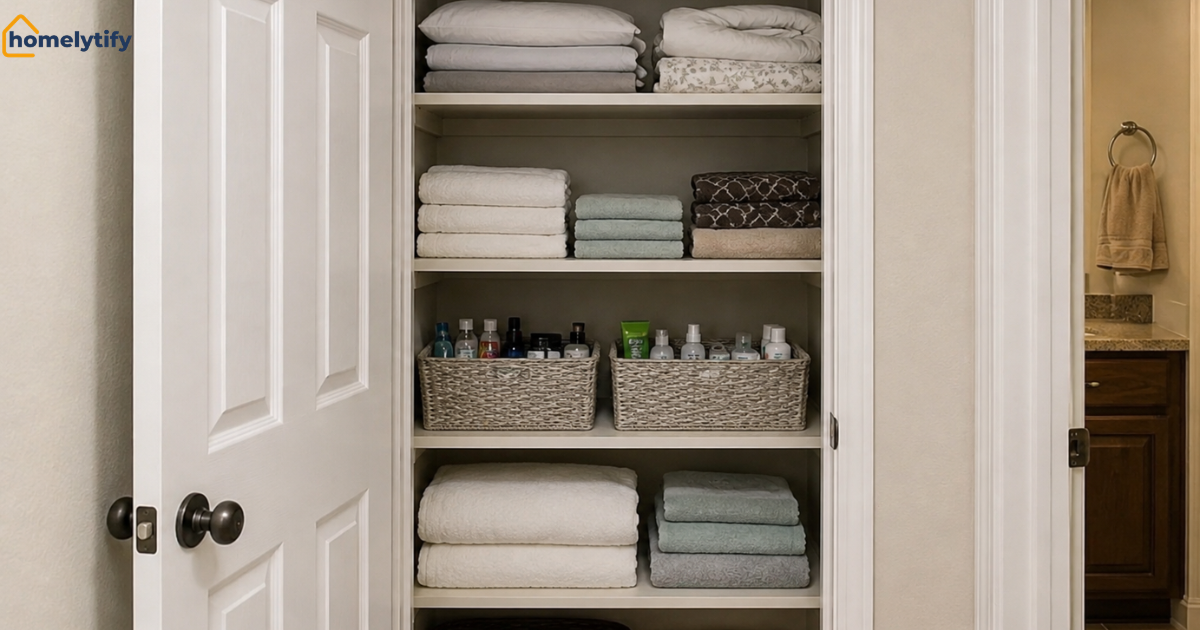
How to Organize a Linen Closet With Deep Shelves: 15 Storage Ideas
If you know how to use deep shelves in a linen closet, they can be very helpful. Otherwise, they can make things harder to find. You reach in for a fitted sheet, and three folded towels fall out behind it. If you’re wondering how to organize a linen closet with deep shelves, you’re not alone. These shelves can be hard to use because things often get pushed to the back and then forgotten.
Deep linen closet shelves give you more storage space, but that extra space can sometimes create problems. Things you rarely use can sit in the back for months, while your everyday towels get buried under other items and the piles start to fall over.
You can fold everything neatly, but that still may not solve the problem. You also need a way to use the back of the shelf without making it difficult to reach your things.
The good news is that you don’t need an expensive closet system or a big renovation. You can make your linen closet easier to use with a few simple storage ideas for deep shelves.
In this guide, you’ll find 15 practical ways to organize deep linen closet shelves, from simple folding tricks and storage bins to easy ways to make better use of the back of each shelf.
What You Need Before You Start
You do not need a custom closet system to organize deep shelves. A few simple and inexpensive items can make this job much easier.
| What can help | What you can skip |
| Open-top bins or baskets for each shelf area | Expensive custom closet systems |
| Shelf dividers for wide shelves | Built-in drawer inserts |
| A label maker, or masking tape and a marker | Matching designer bins |
| A step stool for the top shelf | Expensive storage products |
| One or two turntables for small items | Buying more storage than you actually need |
You do not have to spend a lot of money on storage bins. Some basic bins can work just as well as expensive ones if they are the right size and shape for your shelf. You can also find cheap storage without buying furniture if you want to organize your home on a budget.
How to Organize a Linen Closet With Deep Shelves
The best way to organize deep shelves is to group similar items together and keep the things you use every day within easy reach. You can use the back of the shelf for things you do not need often instead of letting loose piles build up there.
Here is a simple way to get started:
- Take everything off the shelves.
Sort your linens into groups, such as sheets, towels, blankets, and extras. - Remove anything you no longer need.
Set aside items that are badly stained, worn out, or no longer useful. - Give each shelf a job.
For example, use one shelf for towels, another for sheets, and another for blankets. - Use the back of the shelf for less-used items.
Put extra linens or storage bins toward the back while keeping everyday items closer to the front. - Label your shelves and bins.
Clear labels make it easier to find things and help everyone put them back in the right place.
Once you have this basic setup, the 15 ideas below can help you make better use of deep shelves without making them harder to use.
15 Storage Ideas for Deep Linen Closet Shelves
When you use the space in the right way, deep shelves can work well. These simple ideas can help you keep your linens easy to reach, easy to see, and easy to put away without making the closet harder to use.
1. Use the File-Fold Method for Sheets
The file-fold method can help you keep sheet sets upright instead of stacking them in a tall pile. You fold each set into a smaller rectangle or square and place it upright, like a file. This way, you can see and pull out one set without moving the others.
This method works especially well on deep shelves because it keeps the sheets from forming a pile that can easily fall over.
2. Stack Towels by Set, Not by Type
Keep a bath towel, a hand towel, and a washcloth together as one set. Fold them together and place the set on the shelf instead of keeping each type of towel in a separate pile.
This way, you can find everything you need at once instead of searching through different piles.
3. Fold Towels Vertically
Fold your towels vertically and place them upright next to each other instead of making one tall stack. This way, you can see each towel and pull one out without disturbing the others.
This method also helps you use the shelf space better, especially when the shelf is deep.
4. Keep Sheet Sets Together With a Pillowcase
Fold the sheets and keep them together with one of the matching pillowcases. This keeps the flat sheet, fitted sheet, and pillowcases together, so you can easily find the whole set without searching through the closet.
It also helps keep loose sheets from getting mixed up on deep shelves.
5. Use Bins for the Back of the Shelf
Use bins for the back of the shelf instead of loose bundles. You can use them for extra towels, sheets, or other linens and pull the bin forward when you need something.
This keeps items at the back from getting buried or forgotten.
6. Choose Short, Wide Bins
Choose wide and short bins instead of tall ones. They can fit easily on deep shelves, and you can keep more items inside them without making them hard to reach. When you need something, you can easily pull the bin forward.
When you buy bins, measure your shelf first to make sure they fit properly without sticking out.
7. Color-Code Bins by Category
Use color-coded bins for different categories of linens. You can use white for bedding, blue for bath towels, and green for extra items.
This trick makes it easier to find what you need without reading every label. It can also help children and other family members find the items and put them back in the right place.
8. Create a Bin for Orphan Linens
Use a small bin for orphan linens, such as single pillowcases, sheets without a matching set, or other loose linens. You can keep these items together until you find a match or decide what to do with them.
This keeps your main shelves neat and stops loose pieces from getting mixed in with complete sets.
9. Use Turntables for Small Items
Use a turntable for small items that are easy to lose at the back of a deep shelf. You can use it for fabric sprays, small cleaning cloths, or other small linen-care items. The turntable can spin and bring what you need to the front instead of making you reach behind everything.
Choose a turntable that fits your shelf and does not take up too much space.
10. Store Out-of-Season Bedding at the Back
Store out-of-season bedding, blankets, comforters, or other items you do not use often toward the back of the closet. This keeps the front part of the shelf free for linens you use regularly.
If you have deep shelves, use the back space for these less-used items instead of everyday towels and sheets.
11. Use Stackable Bins With Lids
Use stackable bins with lids for items you do not need often, especially on the top shelf. The lids help keep the linens clean, and the bins can be stacked easily without the contents falling out.
Label each bin so you know what is inside without having to open every bin.
12. Use an Over-the-Door Organizer
Use an over-the-door organizer for small items such as washcloths, extra pillowcases, or cleaning cloths. The door gives you extra storage without taking up space on the shelves.
Before buying one, make sure the door can close properly with the organizer in place.
13. Use Shelf Dividers
Use shelf dividers to keep folded towels, sheets, or blankets from leaning or falling over. They are especially helpful on wide shelves, where bundles can spread into each other.
Place a divider between different groups so each stack stays in place and is easier to manage.
14. Pull Bins Forward When You Need Them
When you need something inside the bin, pull the whole bin forward. This is easier than reaching behind other items or taking everything off the shelf.
When you are finished, slide the bin back into its place so the shelf stays easy to use.
15. Do a Two-Minute Weekly Reset
You should take two minutes once a week to fix stacks that have moved out of place. This small habit keeps the closet from becoming messy again.
You do not need to reorganize the whole closet every week. A quick reset is usually enough to keep things easy to find.
Mistakes That Can Make Deep Shelves Worse
A few common mistakes can make your closet difficult to use. Here are some things to avoid when organizing deep linen closet shelves.
Buying bins before measuring. When a bin is too deep, it may stick out from the shelf or stop the door from closing properly. First, measure your shelf, then choose bins that fit comfortably.
Mixing different categories together. When you mix different categories, such as towels, sheets, and blankets, the shelf may look tidy at first. However, you may have to move several items to reach what you need. Give each shelf or area one main category.
Ignoring the top shelf. Some people ignore the top shelf because it is harder to reach. It can quickly become a place to throw things you do not want to deal with. Use it for a clear purpose, such as storing guest linens or seasonal bedding.
Skipping labels because you think you will remember. Do not skip labels on the bins just because you think you will remember what is inside. You may remember it for a short time, but that can change after a few weeks. A simple label makes it easier to find things and helps every member of the family put them back in the right place.
How Often Should You Reorganize a Linen Closet?
I think you do not need to reorganize your whole linen closet very often. A full check once or twice a year is enough to remove worn-out items. I usually reorganize my whole linen closet after each season, and this is enough to keep it in good shape. I check the back of the shelves and make sure everything still has a place.
When you do a full reset, take a few minutes to:
- Check for linens that are worn out, thin, or no longer comfortable.
- Look through the back of the shelves for items you forgot about.
- Refold anything that has fallen out of place.
- Check that your labels still match what is inside each bin.
If you find yourself reorganizing the closet much more often, your categories may be too broad. For example, keeping bath towels separate from beach towels can make the system easier to maintain.
Conclusion
Deep shelves can make your linen closet harder to use, but the right setup can make them much easier to manage. The key is to make sure the things you use often are easy to reach and the space at the back has a clear purpose.
You do not need to follow all 15 ideas at once. Start with a few that fit your closet, such as using bins at the back or changing the way you fold your sheets and towels.
Once you find a setup that works for you, it will be much easier to keep your linen closet neat. You will also be able to find what you need without digging through every shelf.
Frequently Asked Questions
How to organize a very deep linen closet?
Start by keeping the linens you use most often near the front and less-used items toward the back. Use open bins or baskets for items at the back so you can pull them forward when you need them instead of reaching through several bundles.
What to do with shelves that are too deep?
Use the back of deep shelves for items you do not use often, such as seasonal bedding, guest bedding, or extra towels. For everyday items, shallow bins or baskets can help you bring things forward without digging through the shelf.
How deep should shelves be in a linen closet?
There is no single shelf depth that works for every linen closet. The right depth depends on what you plan to store, but shelves that are too deep can make everyday linens harder to reach.
What is the best towel organizer for a linen closet?
The best towel organizer is one that fits your shelf and lets you find what you need without moving everything else. Open bins, shelf dividers, and vertical towel storage can all work well, depending on the size and depth of your shelves.
How should linen be arranged?
Group similar items together, such as towels, sheets, blankets, and pillowcases, and give each group its own space. Keep the linens you use most often where they are easy to reach and place seasonal or extra items farther back.