

How to Store Clothes in a Small Room Without a Wardrobe: Easy Tips
You moved into a small room, maybe a rented flat, a studio apartment, or a shared house, and there’s no built-in wardrobe in sight. Your clothes are piling up on chairs, stuffed into laundry bags, or squeezed into a single corner with no real system. Sound familiar?
Figuring out how to store clothes in a small room without a wardrobe is one of those problems that feels overwhelming at first but becomes very manageable once you have the right approach. The mistake most people make is jumping straight to buying storage products without thinking about how their space actually works.
This guide walks you through a practical, room-by-room system, no expensive furniture required, no drilling if you’re renting, and no vague advice like “declutter and stay organised.” Just straightforward methods you can actually put in place this weekend.
Start With a Clothing Audit, not a Shopping Trip

Before you buy a single rail, bin, or basket, you need to know exactly what you’re storing. Most people skip this step and end up with storage solutions that don’t fit their actual wardrobe.
Lay everything out. Yes, everything. Pull clothes from under the bed, from the corners of the room, off the chair where they’ve been living for two weeks. Sort them into three piles: keep, donate, and seasonal.
Here’s what this audit usually reveals: most people are trying to fit 60% more clothes into a space than it realistically holds. A small room isn’t the problem; too many clothes for that space is. Once you cut down to what you actually wear, the storage problem usually halves itself. If you haven’t touched something in eight months, it doesn’t need prime real estate in your room.
How to Store Clothes in a Small Room Without a Wardrobe: Build Your System First

Buying a rack before you know your storage zones is how you end up with a cluttered room that just looks cluttered with nicer equipment. Think of your small room as having three distinct areas: visible storage, hidden storage, and transitional storage.
Visible storage is anything you can see, such as open rails, shelf units, and wall hooks. Hidden storage is out of sight under the bed, inside ottomans, and behind doors. Transitional storage is for clothes you’ve worn once but aren’t ready to wash, hooks behind the door, a small stool, or a designated spot on the shelf.
The Three-Zone Method That Actually Works
Map these three zones before you move anything. Stand in the middle of your room and look at every wall. Ask yourself: what’s wasted space here? Most small rooms have at least one bare wall, a door with unused back space, and a bed with nothing underneath. Those three spots alone can handle a full wardrobe if you plan them right.
Zone 1 (visible) handles your most-used, current-season clothes. Zone 2 (hidden) holds folded items, off-season clothes, and extras. Zone 3 (transitional) is small, just two or three hooks for the in-between stuff. This structure keeps things from piling up randomly because everything has a designated place.
Use Vertical Space Before You Use Floor Space
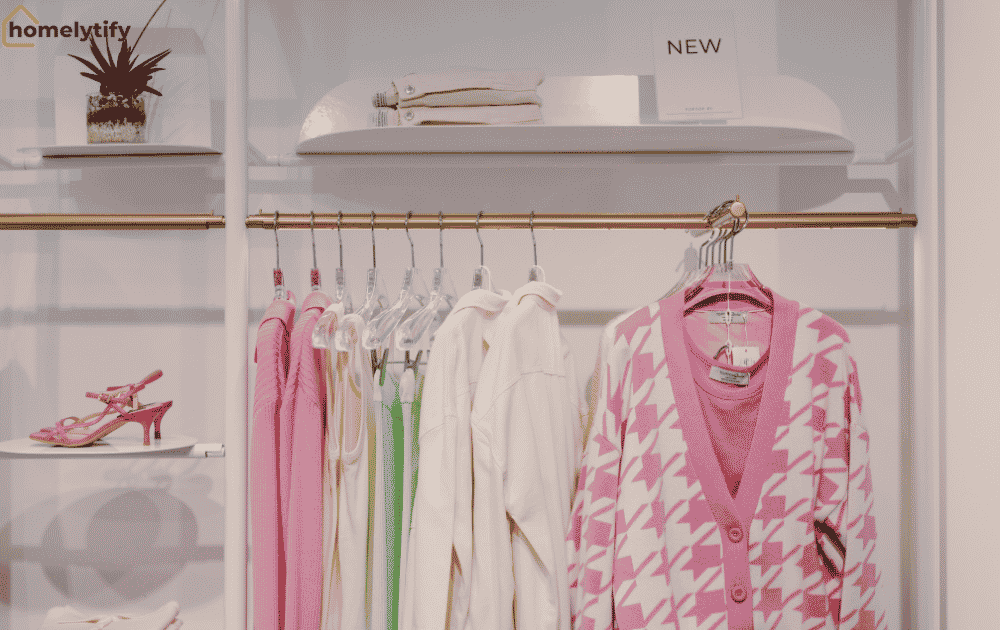
Floor space in a small room is precious. Once you start stacking things on the floor, the room instantly feels smaller and harder to navigate. The solution is to think vertically; walls go all the way up, and most people use only the bottom half.
A shelf unit that reaches close to the ceiling holds far more than a low, wide unit. The same principle applies to hanging rails with double rods, one rod at the top for shirts and blazers, one halfway down for folded trousers or shorter items. You’ve essentially doubled your hanging space without taking up any extra floor area.
Wall-Mounted Rails and Hooks
A simple wall-mounted clothes rail costs very little and keeps your hanging clothes visible and accessible. If you’re renting and can’t drill into walls, look for tension rod systems that fit between two walls, or freestanding pipe rails that stand on their own. The key is keeping it clean. Too many items on an open rail look messy fast. Stick to one category per rail: all tops, or all outerwear, not a random mix.
Heavy-duty adhesive hooks (the kind rated for 3–5 kg) work well for bags, belts, jackets, and accessories on walls or doors. One row of five hooks on the back of your room door can clear significant clutter off the floor and furniture without a single hole in the wall.
Tall Shelf Units and Ladder Shelves
A tall bookshelf, the kind that’s 180 cm or taller, is one of the most useful bedroom storage solutions without a closet. Use the top shelves for folded clothes in storage boxes, the middle shelves for everyday folded items and accessories, and the lower shelves for shoes or baskets. Ladder shelves work similarly, though they have less surface area. Use hanging fabric baskets on them to multiply the usable space.
Under-Bed Storage: The Most Underused Space in Any Small Room
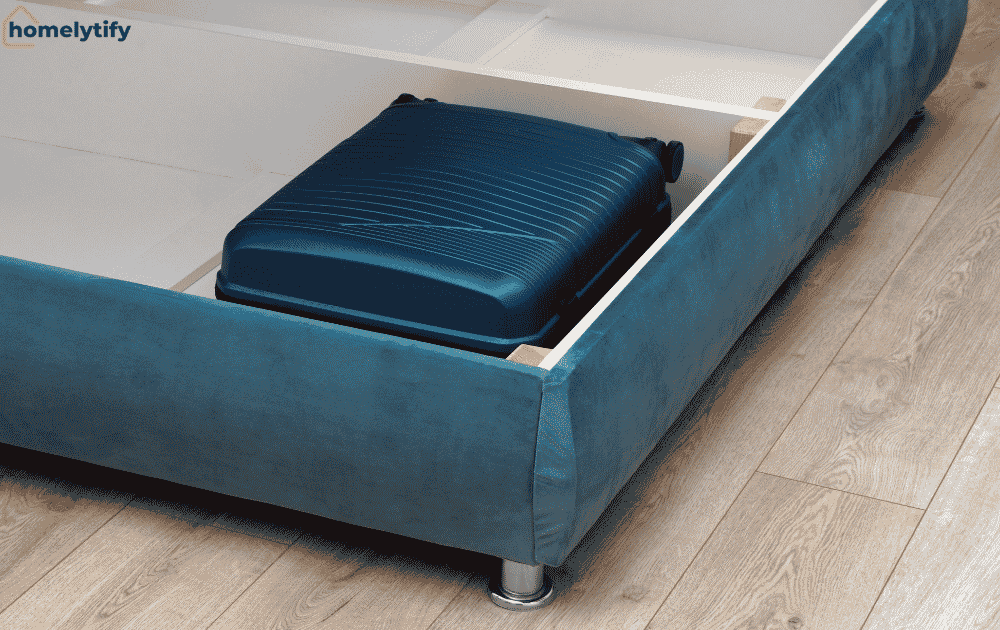
If your bed is sitting on legs with even 20–25 cm of clearance underneath, you’re ignoring one of the most practical storage zones in any small room. Most people never use it at all — and the science suggests that’s affecting more than just how tidy your room looks.
Research published by Nuvance Health (Northwell Health) confirms that bedroom clutter raises cortisol levels, the body’s primary stress hormone, and keeps the brain in a low-level alert state at night, making deep sleep harder to reach. A UCLA study cited in the same piece found that people living in cluttered homes had significantly higher cortisol throughout the day compared to those in organised spaces. So getting clothes off your floor and into structured under-bed storage isn’t just about appearances — it has a real effect on how well you rest.
Flat storage bins with lids, sometimes called under-bed boxes, slide in and out easily and hold more than most people expect. Use one for off-season clothes (winter jumpers in summer, shorts in winter), one for spare bedding, and one for shoes you don’t wear every day. Label them clearly, or you’ll forget what’s inside and stop using them within a month.
If your bed sits low to the ground, bed risers are the simplest fix. They’re inexpensive plastic or wooden blocks that lift the bed frame by 10–15 cm, require no tools, and instantly create a usable storage zone where there wasn’t one before. For many people in studio flats, this single change eliminates the need for a chest of drawers.
Vacuum storage bags are worth using for bulky items, winter coats, thick jumpers, and duvets. They compress down to a fraction of their original size, the bags slide flat under the bed, and those items disappear completely until the season calls for them. One important note: don’t overpack the bags. If the zip seal is strained, it won’t hold its compression, and you’ll come back to a bag that’s slowly reinflated under the bed.
Done properly, under-bed storage can handle your entire off-season wardrobe, your spare bedding, and your secondary shoe rotation, all out of sight, all organised, and all contributing to a calmer room that genuinely supports better sleep.
Hanging Clothes Without a Wardrobe (And Making It Look Neat)
An open hanging rail is a practical solution, but it can look chaotic if you don’t manage it. I learned this the hard way after moving into a studio room with exactly one bare wall and absolutely nowhere to hang anything. I bought a basic Songmics freestanding clothes rail, loaded it with everything I owned, and it looked like a jumble sale within three days.
The difference between a stylish-looking open rail and a chaotic pile of clothes on hangers isn’t the rail — it’s three small habits.
First, use matching hangers. Mismatched plastic and wire hangers make even neatly hung clothes look disorganised. Thin velvet hangers are cheap, hold clothes firmly without them slipping, and take up significantly less horizontal space than chunky plastic ones.
When I switched to a single set of slim velvet hangers, the same rail with the same clothes on it suddenly looked like it belonged in the room. That’s how much of a difference it makes.
Second, hang by category and colour. All your tops together, all trousers together. Within each category, light to dark. It takes five extra minutes to set up and makes the whole rail look intentional rather than random.
Visitors to that studio room actually asked where I’d bought the “wardrobe system”; it was just one rail, organised.
Third, don’t overcrowd it. Clothes crushed together crease faster and are harder to see. If your rail is packed end to end, you have too many items on it — move some to folded storage or be honest with yourself about what you actually wear.
For small apartment clothing storage where wall space is limited, look for a freestanding rack with a bottom shelf or second rod. Some have small side shelves for folded items or accessories, turning a single rail into a compact all-in-one unit without taking up much floor space. I picked one up for less than the cost of a dinner out, and it handled a full wardrobe between the two rods once I stopped treating it like a dumping spot.
The Fold-and-Stack Method Most People Get Wrong

Most people fold clothes and stack them in a pile. Then they pull from the top, the bottom of the pile never gets used, and the stack collapses regularly. This is a systems problem, not a laziness problem.
The fix is file folding, sometimes called the KonMari method, where you fold clothes into small rectangles and store them upright in a drawer or bin, standing on edge rather than flat. Think of it like files in a filing cabinet. Every item is visible at once. You don’t dig through anything to find what’s at the bottom because nothing is at the bottom; everything stands side by side.
What to Fold vs. What to Hang
Not everything benefits from hanging, and not everything should be folded. Getting this wrong wastes both space and time.
Hang: blazers, structured jackets, dresses, shirts and blouses that crease easily, trousers (on clip hangers to avoid fold lines).
Fold: t-shirts, jumpers (hanging stretches them over time), jeans, casual shorts, underwear, socks, gym wear, and anything thick and bulky.
Jumpers, specifically, should never be hung if you can avoid it. Hangers distort the shoulders over time, especially on heavier knits. Fold them flat and stack them on a shelf, or file-fold them into a bin.
Budget-Friendly Storage Solutions That Don’t Look Cheap
You don’t need to spend a lot to build an organised clothing system in a small room. The best budget-friendly storage solutions for clothes tend to be simple: fabric storage cubes, over-door organisers, stackable clear bins, and tension rods.
Fabric cube organisers (the kind that slot into a frame or sit on shelves) are particularly useful. They’re cheap, can hold a full category of clothing each, and come in neutral colours that don’t look cluttered when visible. A set of six cubes on a low shelf unit can replace a chest of drawers at a tenth of the cost.
Over-door shoe organisers, the kind with clear plastic pockets, aren’t just for shoes. They’re excellent for rolled t-shirts, socks, underwear, scarves, belts, and small accessories. One organiser on the back of a bedroom or wardrobe door holds a remarkable amount and keeps everything visible without using any room space at all.
Stackable clear bins from budget homeware shops are good for folded items on shelves. Clear is better than opaque; you can see what’s inside without opening them, which means you’ll actually use them instead of forgetting what’s there.
The real money-saver here is avoiding repeat purchases. The reason most people spend more than they need to on storage is that they buy the wrong thing first, it doesn’t work, and then they buy something else. Starting with the three-zone plan before spending anything prevents that cycle.
Renter-Friendly Hacks That Leave No Damage Behind
This is an area where most articles fall short. If you’re renting, you can’t always drill into walls or make permanent changes, but that significantly limits the storage options most guides suggest. Here’s how to work around that.
Tension rods are your best friend. A tension rod fitted horizontally in a corner, between two walls, or inside an alcove can hold hanging clothes without a single drill hole. Make sure you choose a tension rod rated for clothing weight, not just a light curtain rod, or it’ll sag and drop your clothes at 2 am.
Freestanding garment racks need no installation at all. Look for one with adjustable height and a lower shelf. Avoid the very cheap, lightweight ones; they wobble and tip over when you load them properly. Spend a little more on a unit with a heavier base and cross-bar stabilisers.
Heavy-duty removable adhesive strips (the brand-name ones, not cheap knock-offs) can hold small hooks, shelves, and even light rail brackets. Follow the instructions exactly; the weight limits are real, and the wall surface matters. They work well on smooth painted walls and poorly on textured or wallpapered surfaces.
Command hooks in a vertical row on the back of a door can replace a hook rack. Spread the weight across multiple hooks rather than hanging everything on one.
Common Mistakes That Make Small Rooms Feel More Cluttered
These are the mistakes that consistently show up, even when someone has bought the right storage products.
Buying storage before editing the wardrobe. More storage doesn’t fix too many clothes; it just gives them a slightly tidier place to pile up. Do the audit first.
Using too many different storage types. Mixing wire baskets, fabric bins, plastic boxes, and wooden crates in the same space looks chaotic. Pick one or two systems and stick with them throughout the room.
Ignoring the door. The back of a bedroom door can hold an over-door organiser, a full-length mirror with storage, or a row of hooks. Most people treat it as dead space.
Only thinking about today’s season. People store their whole wardrobe in visible, accessible spots, including the winter coat collection in July. Off-season items should be in the deepest, least accessible storage, so current-season clothes have prime space.
Not maintaining the system weekly. A small room storage system only works if you reset it regularly. That doesn’t mean a full reorganisation, it means spending five minutes returning things to where they belong before the end of each week. Let it go for three weeks, and you’re back to square one.
Conclusion
Living without a built-in wardrobe in a small room isn’t as limiting as it feels on day one. The real issue is almost always a lack of system, not a lack of space.
Build your three storage zones first: visible, hidden, and transitional. Use vertical space on your walls before you sacrifice any floor area. Get under-bed storage working for your off-season and folded items. Keep your open rail clean, consistent, and uncrowded. And before you spend anything on new products, do the clothing audit and cut down on what you actually wear.
No wardrobe storage solutions have to look temporary or makeshift. Done thoughtfully, an open rail, a tall shelf, and well-placed under-bed boxes can work better than a cramped wardrobe because everything is visible, accessible, and organised in a way that makes sense for how you actually live.
Start with what you have. Add one zone at a time. You’ll have a functional, tidy system in place much faster than you’d expect.
Frequently Asked Questions
What’s the cheapest way to store clothes without a wardrobe?
Start with what you already have: clear bins, shelves, or even suitcases under the bed. Over-door organisers and tension rods are among the cheapest purchases that make an immediate difference without any installation.
How do you keep an open clothing rail from looking messy?
Use matching slim hangers, group by category, and don’t overcrowd it. A rail with 20 well-spaced items looks far better than 40 crammed together, even if the clothes themselves are identical.
Can you store all your clothes under the bed?
Folded items, off-season clothes, shoes, and bulky knits, yes. Anything that needs to hang daily. Under-bed storage is best for overflow and seasonal rotation, not your everyday wardrobe
What’s the best way to store jumpers and knitwear without a wardrobe?
Fold them flat or file-fold them upright in fabric bins or on shelves. Never hang heavy knitted hangers that distort the shoulders and stretch the fabric over time.
How do I store clothes in a small room if I can’t make holes in the walls?
Use freestanding garment racks, tension rods (fitted between walls or in corners), and heavy-duty removable adhesive hooks. These are all renter-friendly and can be removed without leaving any damage behind.

One Comment