
7 Budget Home Tips You Can Do in One Weekend
Most budget home tips you find online either require a full week of effort or a shopping trip that defeats the whole budget part; neither of those works in real life.
You’ve got a weekend. Maybe Saturday afternoon and a few hours Sunday morning. The kids are around, or you’re tired from the week, or both.
But the house has reached that point. The point where you open a drawer and something falls out, and the counter disappears under things waiting to be “dealt with.”
It’s also the point where you start avoiding a certain corner because it just feels like too much. That feeling is real. And it’s fixable on a weekend without spending money.
These seven budget home tips are built around one honest rule: do less than you think, but do it completely, no half-finished projects.
No moving clutter from one room to another. Just focused, specific actions that make a visible, lasting difference by Sunday evening.
Here’s exactly how to make it happen.
Why Budget Home Tips Matter for Small Homes

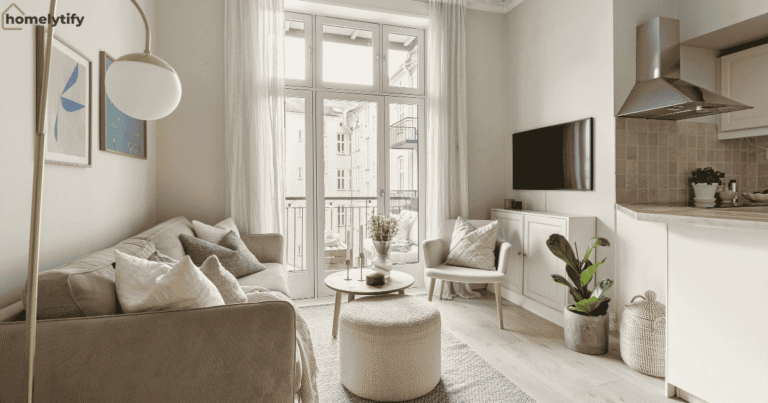
Small homes don’t forgive clutter the way big ones do. One pile of mail on the counter, and the whole kitchen feels chaotic.
That’s not an exaggeration. In a small home, visual clutter in one area affects how the entire space feels. There’s no spare room to absorb the overflow.
No hallway long enough to hide things at one end. Every disorganized corner is visible from somewhere else.
Budget home tips matter here more than anywhere because small home problems get expensive fast. When you can’t find things, you replace them.
When storage is chaotic, you buy more storage. When no system exists, you spend weekend after weekend cleaning the same spaces without anything actually changing.
The real value of budget organization isn’t just saving money on bins and baskets. It’s about stopping the slow financial drain of a home that doesn’t work.
That drain shows up in replaced items, impulse storage buys, and takeout orders because the kitchen is too messy to cook in.
A small home that functions well punches well above its square footage. And it doesn’t require a renovation or a large budget to get there.
What You Can Achieve in One Weekend with Budget Home Tips
One weekend, done right, can genuinely transform how a home feels. Not the whole house, but the parts that matter most daily.
Most people underestimate what’s possible in two days when the work is focused. They try to do everything and end up accomplishing nothing.
Or they assume they can’t make a real difference in a short time, so they don’t try at all. Both of those are wrong.
When I try to do too many things at once, I end the weekend with more mess instead of progress. But if I focus on a few things from the start, I get more done in less time.
A realistic weekend can deliver clear, visible progress without trying to fix everything at once. You can fully declutter and reorganize one living area, keep one kitchen counter consistently clear, and restore one bedroom surface to proper use.
Then set up two or three storage systems using what you already own. That’s not a small result; it’s a home that feels noticeably different by Monday morning.
The key is sequencing. Do the right things in the right order, and the effort compounds. Do them in the wrong order, and you end up exhausted with a house that looks worse than when you started.
That’s what these seven tips are designed to prevent.
7 Budget Home Tips You Can Do in One Weekend

These aren’t ideas you read and file away. Each one is a specific action with a clear start and a clear finish. Do them in this order, and the weekend builds on itself.
Declutter One Small Area First
Don’t start with the hardest room. Start with the smallest completable win.
Pick one zone: a single drawer, one bathroom cabinet, the surface of a nightstand. Empty it. Then decide what goes back in based on one question:
Have I used this in the last year? If yes, it stays. If not, it leaves. No maybes. No “I might need it someday” exceptions.
Finish that zone before touching anything else. Put the kept items back neatly. Remove the discarded items from the house, not to another room, but out of the house.
Here’s why this matters: finishing something small gives you the momentum to continue. Most people start with the hardest space, hit a wall, and abandon the whole project. Starting small and finishing builds confidence that carries into the next task. It sounds almost too simple, but it works every time.
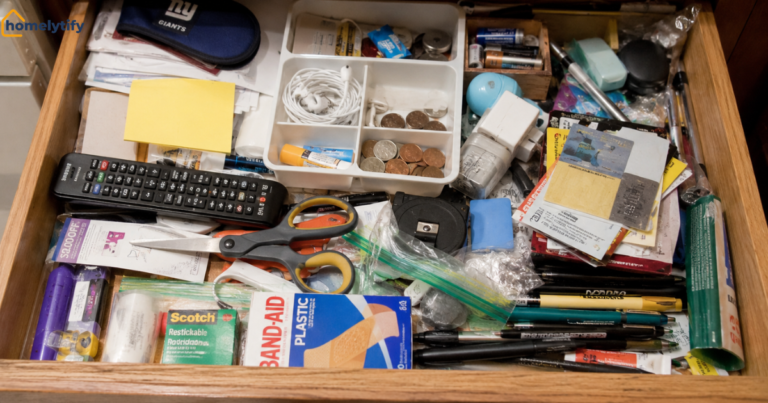
A real example: start with the junk drawer in the kitchen. Most junk drawers have dozens of items with no purpose: old menus, dead batteries, keys to nothing, cords for devices you no longer own.
Thirty minutes and a trash bag can clear it. That drawer now functions. That win makes the next one feel possible.
I did this with the drawer next to our kitchen sink. It had been the catch-all for everything nobody knew where to put: rubber bands, expired coupons, a broken flashlight, and at least four mystery keys. I gave it thirty minutes on a Saturday morning. Just that drawer.
By the time I finished, the whole kitchen felt different somehow. Not because I had done much, but because something was actually done. That drawer stayed organized for months because the system was simple enough to maintain without thinking about it.
Use What You Already Have for Storage
Before buying a single organizer, walk through your home and look for items that could serve as storage.
Shoeboxes become drawer dividers. Mugs hold pens, scissors, or kitchen tools. Baskets from other rooms relocate to where they’re more useful.
A tension rod placed under the kitchen sink creates a second level for spray bottles. Empty glass jars become desk supply holders, bathroom organizers, or pantry containers.
This isn’t about making things look Pinterest-perfect. It’s about solving specific storage problems with zero spending.
The exercise also serves a useful purpose: it forces you to really look at what you own before deciding you need more.
Set aside one hour on Saturday morning for this. Walk through every room with a notepad. Write down what storage problems exist.
Then look for items you already own that could solve each one. You’ll be surprised by how many free solutions are already in your house.
Rearrange Furniture to Create Instant Space
Moving furniture costs nothing and can make a room feel larger without removing a single item.
Most furniture arrangements are accidental things that landed somewhere when you moved in and stayed there without thought. A fresh eye on the arrangement can reveal unused space, better traffic flow, and a room that simply functions better.
Try moving the bed against the longest wall if it’s currently floating in the center. Push the sofa back to create more open floor space.
Move a piece of furniture that’s blocking natural light. Rotate the desk to face a different direction.
The rule is: anything that opens floor space is worth trying. Floor space reads as living space. Furniture touching every wall creates a boxed-in feeling.
Even two inches of clearance between furniture and a wall changes how a room feels. Spend an hour on Saturday afternoon rearranging one room and standing in the doorway afterward. The difference is often immediate.
Focus on High-Impact Areas in Your Home
Every home has two or three spots that, when cluttered, make the whole house feel chaotic and, when clear, make everything feel manageable.
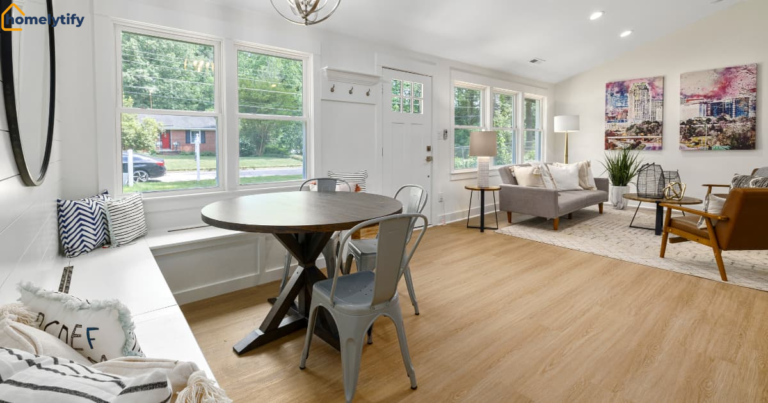
For most homes, those spots are the kitchen counter, the entryway, and the main living area surface. These are the places everyone sees multiple times daily.
They’re also the places that accumulate clutter fastest because they’re used most.
Make these your priority. Not the spare bedroom that’s mostly behind a closed door. Not the garage. The spaces that affect how you feel about your home every single day.
Clear the kitchen counter down to only what’s used daily. Set up a simple landing zone in the entryway: one hook for bags, a small tray for keys, a basket for incoming mail.
Clear the coffee table or living room surface to a deliberate, minimal arrangement.
When the high-impact areas are under control, the home feels organized even when other areas aren’t perfect yet. This is the psychological leverage point most organizations’ advice misses.
Create a Simple Weekend Reset Routine
A reset routine isn’t about cleaning. It’s about returning the home to its baseline before the week starts.
Here’s a specific version that takes thirty minutes on Sunday evening.
First ten minutes: do a full walk-through and return anything out of place to its designated home.
Second ten minutes: clear and wipe down all main surfaces, kitchen counter, dining table, and coffee table.
Final ten minutes: deal with anything that doesn’t have a home yet, give it one, or remove it.
That’s it, thirty minutes, every Sunday. This isn’t a deep clean or a full reorganization session, just a reset.
The difference between homes that stay organized and homes that cycle between chaos and cleanup is almost always this habit.
Small, consistent resets prevent accumulation. Without them, a week of normal living undoes a weekend of organization work.
Write it into your Sunday schedule. Block the thirty minutes. Treat it as non-negotiable for the first month until it becomes automatic.
Avoid Buying Storage Before Decluttering
This tip is listed sixth because that’s usually when the urge to go shopping kicks in. It tends to happen partway through the weekend, after some space has been cleared and motivation starts to build.
Resist it completely. Here’s why: you don’t know what storage you need until you know exactly what you’re storing and how much of it there is. Buying bins and baskets mid-process means buying them for the wrong volume or the wrong dimensions.
Finish the decluttering first. Then assess what actually needs a storage solution. Then, if something specific is needed, buy that one specific thing.
Not a set of twelve matching bins. The one thing that solves the one remaining problem.
This is where most budget organization attempts become expensive. The organization aisle is genuinely designed to make you feel like you need everything there.
You probably need one or two things at most, after decluttering, if anything at all.
Organize One Room Instead of the Whole House
The single biggest mistake people make with weekend organization is trying to fix everything. They start in the kitchen, then drift to the bedroom and pull things out of the living room.
By Sunday evening, they’re left with three unfinished rooms and a house that looks worse than when they started. Pick one room on Friday night, commit to it, and finish it before you touch anything else.
The room you pick should be the one that bothers you most daily. Not the one with the most to do, but the one whose disorganization costs you the most frustration, time, or peace.
For most people, that’s the kitchen, for others it’s the bedroom, and you know which one it is.
By Sunday evening, that room is done. Decluttered, reorganized, and set up with systems that will hold. That one finished room creates a standard for the rest of the house, a visible proof that this is possible, and a clear example of what is done.
Avoid Common Mistakes in Budget Home Tips Organization

Most weekend organization attempts fail not because of a lack of effort, but because of a few specific decisions made early that set the whole thing off course.
The mistakes aren’t obvious at the moment. They feel like the right moves. That’s what makes them worth knowing before the weekend starts.
- Starting with the most overwhelming space. It feels logical to tackle the worst area first while energy is high.
In practice, it burns out motivation before any real progress is made. Starting with the smallest completable win builds momentum that carries through the weekend.
- Buying storage products before finishing the declutter. Mid-process shopping is where budgets break, and the real problem gets avoided.
Buying bins for clutter doesn’t solve clutter; it organizes it. Finish removing what doesn’t belong before deciding what storage is actually needed.
- Moving things from room to room instead of making decisions. When an item doesn’t have a clear home, the easy response is to move it somewhere else temporarily.
That somewhere else becomes permanent within a week. Every item that comes out during the weekend needs a decision: a specific home, a donation bin, or the trash. No temporary holding areas.
- Trying to make it look like a staged photo. An organization that’s designed to look impressive rather than function in real life falls apart fast.
A beautiful arrangement of matching containers that takes ten minutes to undo every morning is the wrong system. Functional beats are beautiful in a home that’s lived in daily.
- Doing it alone when others live in the house. Organizing a shared home without involving the other people in it creates systems that only one person understands or cares about.
Those systems break down immediately. Even a brief conversation here’s where things go now, here’s the new rule for the counter dramatically improves how long the changes hold.
How to Keep Your Home Organized After the Weekend
The weekend work holds only if two simple habits follow it. Not complex routines. Just two things done consistently.
The first is the daily one-touch rule. The moment something is picked up or comes into the home, it goes directly to its designated home. Not on the counter to deal with later. Not on the chair until after dinner.
This habit, practiced for two to three weeks, becomes automatic and eliminates most daily clutter before it accumulates.
The second is the weekly Sunday reset described earlier, thirty minutes to return the home to its baseline before the new week starts.
This catches anything the daily habit misses and prevents slow drift from becoming visible chaos.
Beyond those two habits, do a light reassessment monthly. Walk through the organized areas and notice what’s working and what isn’t. A system that made sense on the first weekend might not match how you actually live a month in.
Organization isn’t a one-time perfect setup; it’s a system that should evolve with your actual life. The homes that stay organized after a reset weekend aren’t the ones with the most systems. They’re the ones with the simplest systems, maintained honestly.
Conclusion
A focused weekend can improve your home not through big changes, but by fully completing a few simple steps in order. The main idea is that finishing one space properly is better than partly fixing many spaces.
Choose the area that bothers you most and focus only on that this weekend, using what you already have and avoiding unnecessary buying. Set up a simple system and build basic habits to keep it working.
You don’t need renovation, extra money, or a full week off. Just start this weekend with one small area, finish it, and then move forward from there.
Frequently Asked Questions
How do you organize your home on a budget in one weekend?
Focus on one room or one zone at a time instead of trying to fix everything. Start with the smallest completable area, use what you already own for storage, clear your highest-impact surfaces, and set up a simple Sunday reset routine. Do less than you think, but finish it.
What should I declutter first when organizing on a budget?
Start with the smallest completable zone, a single drawer, one bathroom cabinet, or a nightstand surface. Empty it, use the one-year rule to decide what stays, and remove discarded items from the house immediately. Finishing one small area builds momentum for everything else.
How do you organize a small home without spending money?
Use what you already own. Shoeboxes become drawer dividers. Mugs hold kitchen tools. Tension rods under the sink create double storage space. Empty glass jars organize bathroom and desk supplies. Walk through every room with a notepad and identify free solutions before buying anything.
What are the most common home organization mistakes?
The most common mistakes are starting with the most overwhelming space, buying storage before decluttering, moving items from room to room without making decisions, and trying to organize the whole house in one weekend. Start small, finish, and involve everyone in the household in the new system.
How do you keep a home organized after a weekend reset?
Two habits make the biggest difference. First, the one-touch rule — everything goes directly to its designated home the moment you pick it up. Second, a 30-minute Sunday reset that returns the home to its baseline before the new week starts. These two habits, maintained consistently, prevent clutter from building back up.